


Quick Links:
Decode Behaviour. Understand People. Lead with Impact.
A fundamental misjudgement commonly made by managers is the conflation of 'human problems' with mere 'management process problems'—addressing them through stricter appraisals, optimised procedures, readjusted task allocations, or increased communication.
These approaches are undeniably essential. Yet, when employee motivation declines, team collaboration breaks down, managerial communication fails, or organisational change repeatedly stalls, the root cause often lies not within the process itself, but at a deeper level—within the areas of human cognition, motivation, emotion, interpersonal relationships, and psychological states.
Why does the very same policy trigger entirely different interpretations and responses from different employees?
Why do team members, even with clearly defined objectives, frequently hold back from proactive engagement?
Why do managers, despite persistent communication efforts, struggle to build genuine trust and consensus?
Why does a perfectly rational change initiative still provoke anxiety, resistance, and a pervasive 'wait-and-see' attitude?
Managerial Psychology programme is the discipline well placed to address these critical questions. Grounded in interdisciplinary scholarship spanning management science, organisational behaviour, and psychology, it systematically explains how individuals judge, act, collaborate, and respond to change within the organisational context.
As artificial intelligence reshapes workflows, business transformation accelerates, intergenerational collaboration becomes the norm, and talent mobility intensifies, managers are required not only to establish clear goals, mechanisms, and accountabilities but also to understand human psychology deeply, build collective commitment, and drive intrinsic motivation. This programme constructs a comprehensive learning pathway across four interconnected levels—Individual, Team, Leadership, and Organisation. The ten integrated modules build upon one another sequentially, enabling students progressively to grasp the behavioural logic of people in organisations and translate psychological insights into tangible managerial capabilities.
Programme Design
The 'human problem' in management never occurs in isolation.
An individual's cognition and motivation shape their judgement and behaviour; differences and interactions amongst individuals influence team trust and collaboration; a leader's conduct determines whether team members are willing to commit and follow; and the organisation's systems, culture, and environment continuously shape employee choices and performance.
Individual Cognition: Understand cognition, motivation, emotion, and individual differences to enhance self-awareness, improve interpersonal judgement, and elevate decision quality.
Group Dynamics: Comprehend divergence, conflict, and group interaction to build trust, establish consensus, and drive effective collaboration within diverse teams.
Leadership Ascension: Grasp the psychological mechanisms of influence and leadership to strengthen the capacity for persuasion, cohesion, and team mobilisation.
Organisational Evolution: From employee engagement and organisational change to innovation capability—transform human potential into a sustained driver of organisational growth.
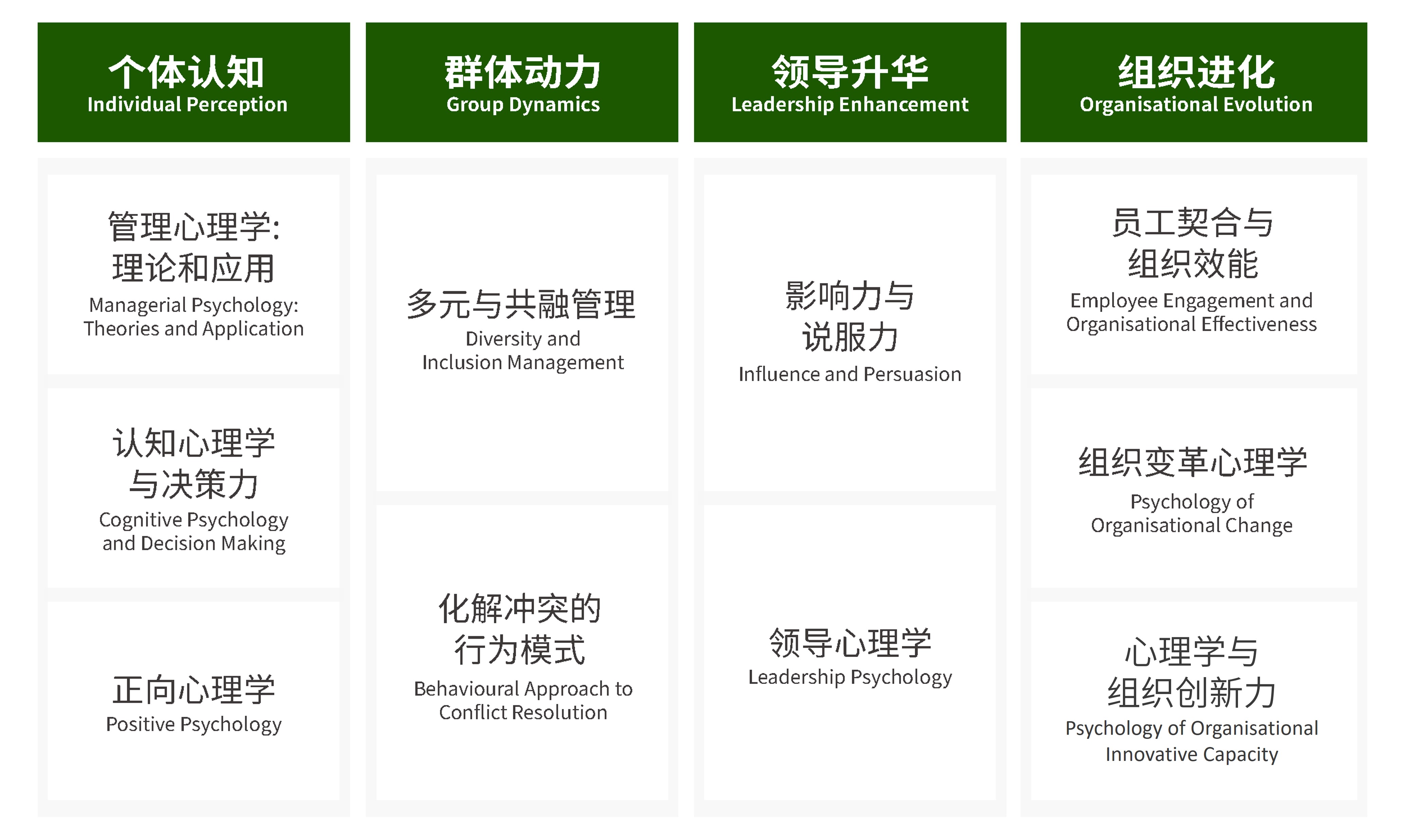
Programme Objectives
MPSY is designed to drive a fundamental role evolution in managers—moving from 'executing tasks effectively through personal expertise and professional skills' to 'understanding diverse individuals, mobilising collaborative teams, and creating value through organisational leverage'. The programme helps students build a systematic managerial psychology perspective: shifting from a narrow focus on tasks, processes, and outcomes to a holistic understanding of cognition, motivation, emotion, relationships, and organisational context; progressing from reliance on personal intuition to judgement informed by empirical evidence and real-world conditions; and evolving from solving immediate problems to diagnosing root causes, influencing team behaviour, shaping organisational environments, and ultimately cultivating a more mature, systematic, evidence-based, and implementable management practice.
Learning Outcomes
Upon completion of this programme, you will be able to:
Truly understand your team members—not by merely observing overt behaviours, but by identifying the underlying motivations, emotions, psychological needs, and situational factors that drive them.
Identify blind spots in your own management approach—recognising the influence of experiential heuristics, habitual thought patterns, and cognitive biases, thereby enabling more deliberate and evidence-informed managerial decisions.
Adapt your management style to different individuals and contexts—tailoring communication, feedback, motivation, delegation, and task allocation with greater precision, rather than applying a uniform approach to all.
Manage conflict more effectively, build trust, and drive collaboration—understanding the positions, interests, and psychological needs beneath divergent perspectives in order to build consensus in cross-functional, diverse, and complex relational settings.
Enhance participation and commitment during organisational change—comprehending the anxiety, resistance, and hesitation triggered by change, reducing passive compliance, and mobilising broader engagement and ownership in the transformation process.
Move beyond addressing isolated personnel issues to shaping the organisational environment—recognising how leadership behaviours, team dynamics, institutional frameworks, and culture collectively affect performance, while fostering a workplace conducive to engagement, growth, and innovation.
Ultimately, you will develop a robust, transferable managerial capability: understanding people, diagnosing contexts, mobilising teams, and driving meaningful change within complex organisations.
Programme Content
- Inauguration Ceremony-cum-Residential Workshop
- Managerial Psychology: Theories and Application
- Cognitive Psychology and Decision Making
- Positive Psychology
- Diversity and Inclusion Management
- Behavioural Approach to Conflict Resolution
- Influence and Persuasion
- Leadership Psychology
- Employee Engagement and Organisational Effectiveness
- Psychology of Organisational Change
- Psychology of Organisational Innovative Capacity
- Final Project
Teaching Members’ Qualifications
This programme is taught by Chinese experts and scholars from the Mainland China, Hong Kong, Macau, Taiwan, and overseas, who possess both a solid theoretical foundation and extensive practical experience, as well as a broad global visiona

陈静女士
Ms Kitty Chen
Academic Stream Leader (Human Capital Management); Former senior executive of multinational corporates; Nearly 20 years of corporate management experience; ICF certified coach

郝永刚博士
Dr House Hao
Academic Advisor & Adjunct Professor; Chief Consultant of Organizational Evolution; Founder of Shanghai Wencheng Huayu Management Consulting Agency

林碧琪博士
Dr Peggy Lam
Part-time Lecturer; Executive Coach; Registered Organisational Psychologist; Ph.D (CUHK) in Psychology

余建中先生
Mr Kin U
Part-time Lecturer; Managing Partner of GML Leadership Consulting; Former Director of Organization and Leadership Development at KPMG

李峰博士
Dr Frank Li
Part-time Lecturer; Founder of Leadership Grammar Model; PhD in psychology from the University of Hong Kong

乔学军博士
Dr June Qiao
Adjunct Associate Professor; Visiting Scholar at Foster School of Business; University of Washington; Ph.D. in Human Resource Development from the Pennsylvania State University

邱敬贤女士
Ms Rosemarie Yau
Part-time Lecturer; Positive Psychology Coach & Trainer specializing in Workplace Wellbeing

吴咏怡博士
Dr Catherine Ng
Adjunct Associate Professor; Pioneering Executive Coach in Asia; Master Certified Coach (MCC); PhD in Middlesex University, UK

马超帆女士
Ms Suprince Ma
Academic Advisor (SHRM) & Adjunct Associate Professor; Former senior executive of Global 500 MNCs w/ HR & OD management experience at China; Asia Pacific & Global Levels, Originator of CHANGES Model

陈永仪博士
Dr May Chen
Part-time Lecturer; Licensed Clinical Psychologist in New York, United States; Associate Professor in the Department of Business Administration and Institute of Cognitive Neuroscience at Central University

尤志欣先生
Mr Eric You
Part-time Lecturer; ICF certified MCC; former OD Head of Tencent Shanghai

董晶磊先生
Mr Tim Dong
Part-time Lecturer; Founder of Legend Learning Consulting Ltd; Senior Soft Skills Facilitator; MBA from the Leeds University Business School, UK

吴大有博士
Dr Ta Yu Wu
Part-time Lecturer, Head of an initiating unit of the International Institute for Advanced Data Management; Initiator of the Global Data Factor 50 Forum; Member of the board of directors of DAMA China

刘庆煜先生
Mr Richard Liu
Part-time Lecturer; Global Employee Communication and Relations Director at TSMC; with more than 20 years of human resource management experience in Asia Pacific and Europe and several Fortune 500 companies

龚炳然博士
Dr Eric Kung
Part-time Lecturer; Founder, Chairman & CEO of Human Dynamic; With over 30 years of experience in people management consulting

李龙乔女士
Ms Annie Li
Part-time Lecturer; Among the First Cohort of Certified Change Management Professionals™ (CCMP™) Worldwide; IAF Certified Professional Facilitator Master (CPF M); Former China Lead, IBM Technology-Driven Change Management Research Council
Programme Highlights
A Real-World Management Scenario Focus: This programme is not an abstract dissemination of psychological knowledge detached from organisational reality. Rather, it is structured around the persistent, practical challenges that managers continually face – decision-making, motivation, conflict, leadership, employee engagement, organisational change, and innovation. Starting from concrete issues encountered in the management setting, it traces the psychological mechanisms that underpin behaviour, ensuring that psychology directly informs and improves managerial judgement and action.
Connecting Global Perspectives with Local Practice: The curriculum integrates influential theories, research findings, and practical experience from the international fields of psychology, management science, organisational behaviour, and neuroscience. At the same time, it carefully examines these frameworks against the cultural characteristics and managerial contexts of Chinese and Asian organisations. Participants not only encounter diverse management philosophies and methods but also critically assess their applicability across different cultures, industries, and organisational stages, ultimately translating global insights into management practices that are grounded in local realities.
Calibrating Managerial Experience with Research Evidence: While experience constitutes a valuable asset, it remains vulnerable to cognitive biases, habitual thinking, and the gravitational pull of past success pathways. This programme places empirical research, organisational case studies, and students' own management experiences side by side for critical examination. We respect experience, but we also interrogate the assumptions and boundaries that lie behind it, enabling managerial judgement to move beyond a sole reliance on intuition and established routine.
Analysing Human Issues through a Multi-Layered Lens: Human behaviour is rarely determined by a single factor. When confronting issues related to employee performance, team collaboration, or organisational effectiveness, this programme resists the temptation to attribute causality too quickly to individual attitudes or capabilities. Instead, it conducts a cross-cutting analysis across multiple levels—individual differences, group interaction, leadership behaviour, and the organisational environment—helping students see the complete underlying structure behind complex problems.
Establishing a Continuous Loop of Learning, Practice, and Reflection: Through theoretical instruction, case-based seminars, classroom interaction, workplace application, and project-based study, this programme weaves knowledge input, contextual application, and critical reflection throughout the entire learning journey. Students can bring new perspectives back to their workplaces for observation and experimentation, and subsequently return to the classroom with practical challenges for further discussion. This ensures that learning deepens continuously through ongoing application and testing.
Suitable for
An Excellent Fit For
Middle and senior managers who are actively leading teams and consistently addressing 'people challenges' – seeking more effective ways to manage motivation, communication, collaboration, conflict, and employee engagement.
HR and Organisational Development professionals looking to move from 'managing tasks' to 'understanding people' – aiming to look beyond systems, processes, and tools to grasp the psychological roots of talent and organisational issues.
Entrepreneurs and senior executives wishing to provide their management experience with a robust scientific foundation – seeking to refine their intuition and strengthen their ability to assess people, exercise judgement, and lead organisations in complex situations.
Business leaders responsible for cross-functional and cross-departmental collaboration – needing to build consensus, exert influence, and drive cooperation even in the absence of direct line authority.
Equally Suited To
Professionals who wish to apply psychological insights to workplace and organisational settings.
Internal trainers, Organisational Development consultants, and management advisors.
Emerging managers who are transitioning into leadership roles and wish to complete this role change systematically.
Managers at all levels who aim to improve team climate, enhance employee engagement, and optimise organisational effectiveness.
This programme does not require a background in psychology. It is best suited to learners who have substantial workplace experience, are willing to reflect critically on their own management practice, and are committed to applying what they learn directly to their real-world working environment.
Alumni
Previous students of this programme came from major companies including: Tencent, Apple, Alibaba, Sina.com, Walmart, New Oriental, Oppo, ABB, Kingdee, Wahaha, Lianyu Logistics, Hire, NetHire (Beijing), Belle International, Adidas, Chanel, Universal Music, Roche Pharmaceuticals, Fortune Pharmaceuticals, China Construction Bank, Industrial and Commercial Bank of China, Lenovo (Beijing), Beijing Capital, Meituan, Pepsi, Bailong Yuntong, Tai Chi Pepsi, Billion Cloud, Taiji, Ruixing Technology and other well-known companies, as well as other small, medium-sized and start-up companies with growth potential.
Graduation Certificate
Postgraduate Diploma in Managerial Psychology
Students who successfully complete and pass all required course modules and achieve a minimum attendance rate of 80% will be awarded the "Postgraduate Diploma in Managerial Psychology" by the University of Hong Kong, a postgraduate-level qualification.
(*To ensure the programme remains both forward-looking and practical, the Institute reserves the right to make necessary adjustments to the curriculum. Updates may be introduced on an ongoing basis; however, the final programme content and arrangements shall be subject to the version announced at programme commencement.)
Fees and Charges
| Application fee: | 500 RMB |
| Tuition fee: | 128,000 HKD |
| Meals and travel expenses: | Students are responsible for their own accommodation and transportation during the programme. |
Programme Enquiries
| Becky Yang - (010) 6596 9976 |
| Tina Zhang - (021) 5067 5009 |
| Jolene Wang - (0755) 2360 4039 |
| Eric Meng - (020) 2206 0509 |
| May Zhang- (028) 8445 4626 |
*To ensure the programme remains both forward-looking and practical, the Institute reserves the right to make necessary adjustments to the curriculum. Updates may be introduced on an ongoing basis; however, the final programme content and arrangements shall be subject to the version announced at programme commencement.