
Low Altitude Economy and Future Technology Management Programme (LATM)

Mode and Schedule:December 9 to 13 2026 (Wednesday to Sunday)
Location:HKU Campus
Medium of Teaching:Mandarin Chinese; supplemented by English
Application Deadline: 2026/12/2
Limited admission of 40 on a first-come, first-served basis      
Background

The low-altitude economy is becoming a key strategic arena in the new global wave of technological and industrial transformation. With the rapid development of unmanned aircraft systems (UAS), eVTOL, AI, digital airspace management and future aviation infrastructure, society is moving toward a new era of advanced air mobility (AAM). China, the Guangdong-Hong Kong-Macao Greater Bay Area and major economies are actively opening low-altitude airspace, building industrial ecosystems and scaling innovation—taking the low-altitude economy from concept to scale.

Yet this is not merely an aviation technology breakthrough. It is a systemic undertaking integrating engineering innovation, operations management, business models, finance, public policy and social governance. The industry no longer needs single-domain specialists, but composite leaders who can cross the boundaries of technology, market and governance—understanding the full industry chain, seizing strategic opportunities, and balancing risk with innovation.

Against this backdrop, HKU Business School (China) launches the Low-Altitude Economy and Future Technology Management Programme (LATM). Integrating aviation safety management, low-altitude flight technology, AI and the digital sky, business model innovation, industry investment, ESG and sustainable development, policy and regulation, and future technology strategy, the programme builds the strategic vision and management capabilities needed for the future aviation ecosystem. Through international case studies, industry practice and interdisciplinary frameworks, it develops business leaders, industry innovators and policy managers who can drive high-quality development of the low-altitude economy.

Toward the future aviation era of 2035, competitiveness will depend not only on how far aircraft can fly or how fast technology iterates, but on whether a safe, efficient, sustainable and commercially viable low-altitude ecosystem can be built. Value in the future sky comes not only from technological innovation, but from excellence in management and governance.

The future sky is not waited for—it is shaped by talent with global vision, technological insight and strategic leadership.

Programme Features
01 5-Day Immersive Programme02 Co-delivered by International Experts and Industry Leaders
03 Cross-disciplinary Integration across Aviation, AI, Finance and Governance04 Case-based Discussions + Integrated Strategy Project
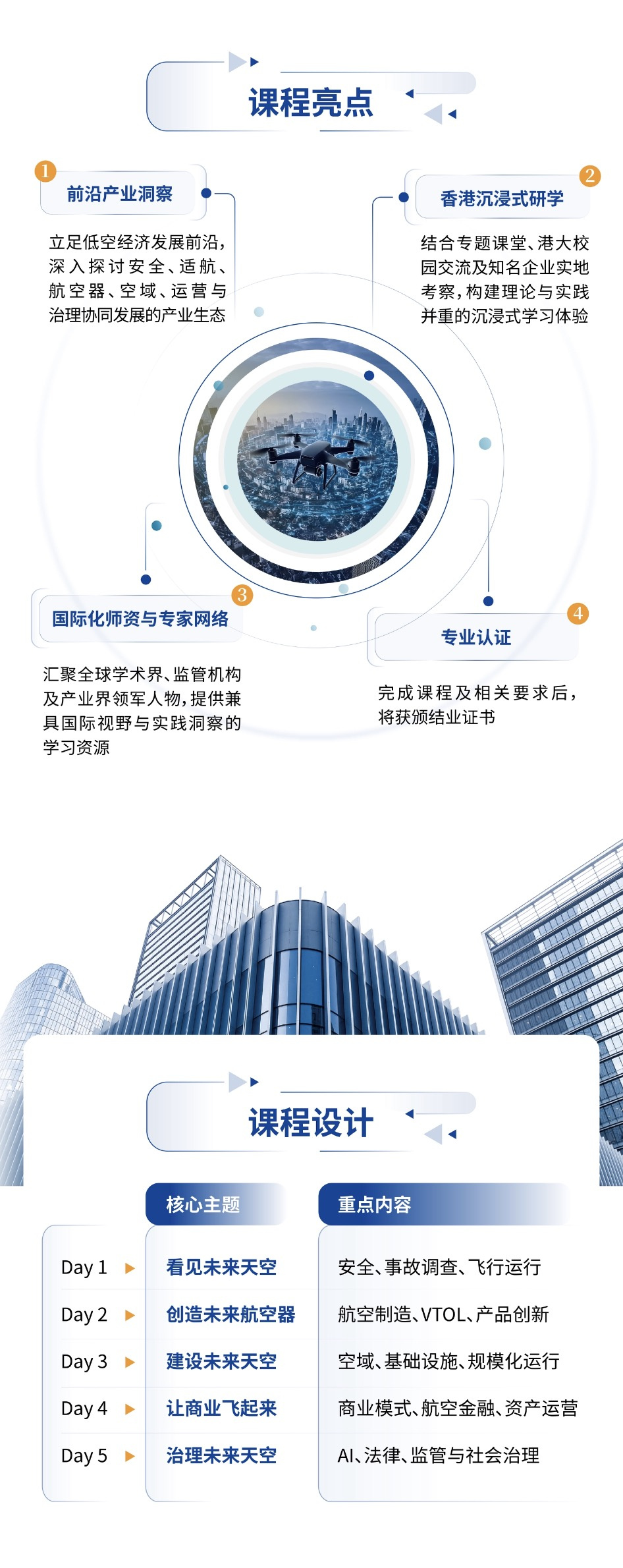
Programme Highlights and Structure
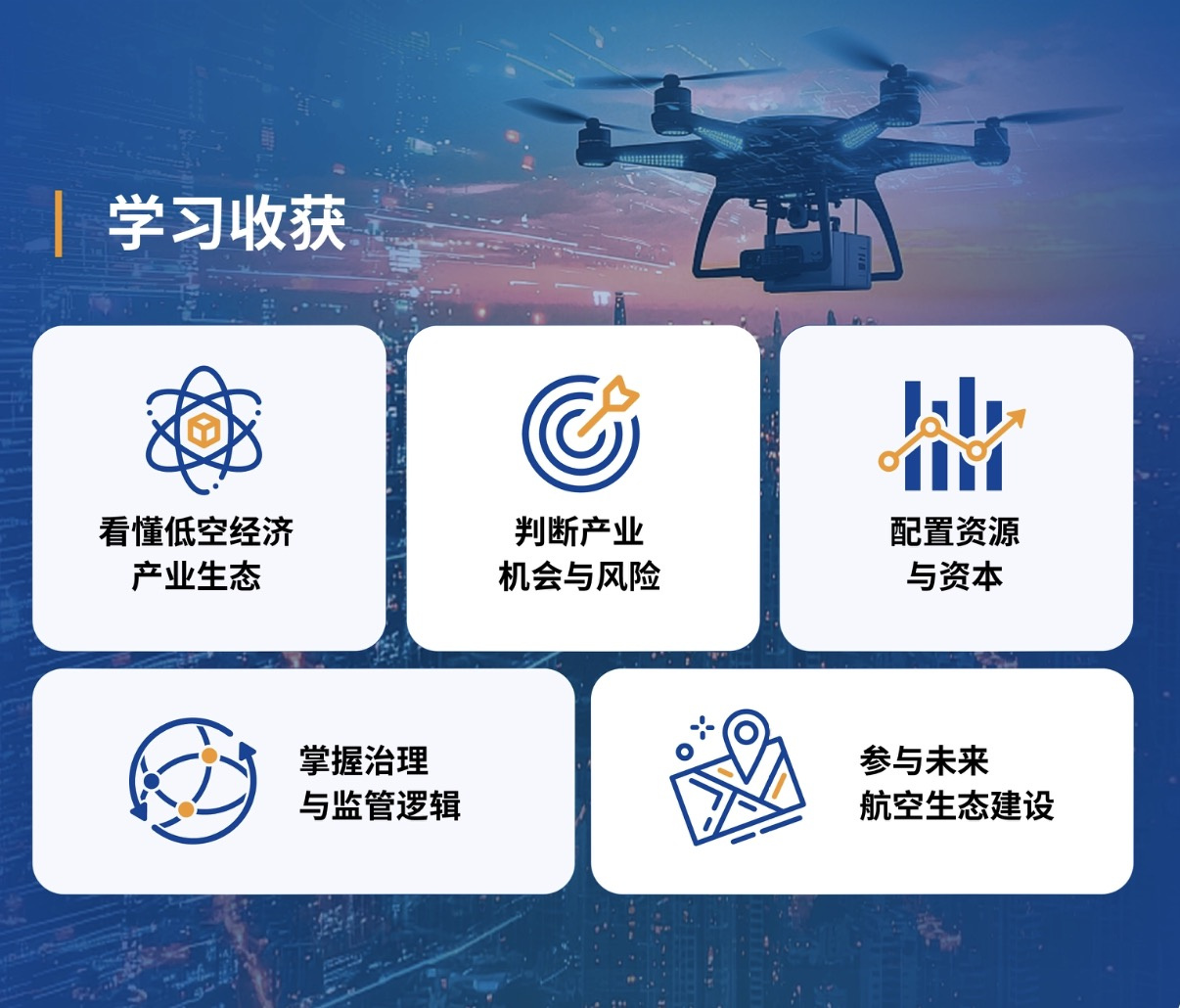
Learning Achievements
Target Participants


  • Low-Altitude Economy & Aviation Managers 
    For managers in aircraft manufacturing, flight operations, drone systems, eVTOL, airspace management, aviation infrastructure, safety regulation and industry services. Moving beyond a single professional lens to understand technology, industrial ecosystem, business logic and governance—strengthening strategic judgement and cross-domain collaboration.
  • Technology & Engineering Leaders 
    For technology managers and R&D heads in AI, smart manufacturing, autonomous systems, aerospace, new energy and communications. Focused on turning innovation into commercial value and industrial application, with strategic vision and governance thinking.
  • Investment, Finance & Industry Development Professionals 
    For investors, industry fund managers, financial institution leaders and corporate strategists in the low-altitude economy and future aviation. Building systematic understanding of value creation through industry chain analysis, business models, aviation finance, asset operations and capital market cases.
  • Policymakers, Regulators & Public Governance Professionals 
    For government, regulatory bodies, industry associations, legal services and public governance. Balancing innovation and public safety through international aviation regulation, airspace governance, safety management, data governance and ESG.
  • Entrepreneurs & Cross-Industry Transitioners 
    For entrepreneurs, senior executives and founders from transport, logistics, energy, telecommunications, smart cities and infrastructure. Rapidly building a panoramic view of the low-altitude economy—opportunities, business scenarios and development paths—to strengthen market entry and strategic positioning.
  • Future Technology & Innovation Ecosystem Builders
    For decisionmakers, innovation platform leaders and ecosystem partners tracking future aviation and emerging tech. Centred on Advanced Air Mobility (AAM), unmanned aircraft systems, AI, digital sky, sustainable aviation and future governance—cultivating strategic leadership and forward-looking decisions for 2035.
  • Especially Suited for
    Senior executives, entrepreneurs, investors and public-sector leaders seeking stronger decisions at the intersection of technology, business and governance; and managers who want systematic thinking, strategic judgement, resource integration and value creation in a fast-changing, uncertain industry. Helping participants understand not only technology but industry—not only trends but how to lead change.
     
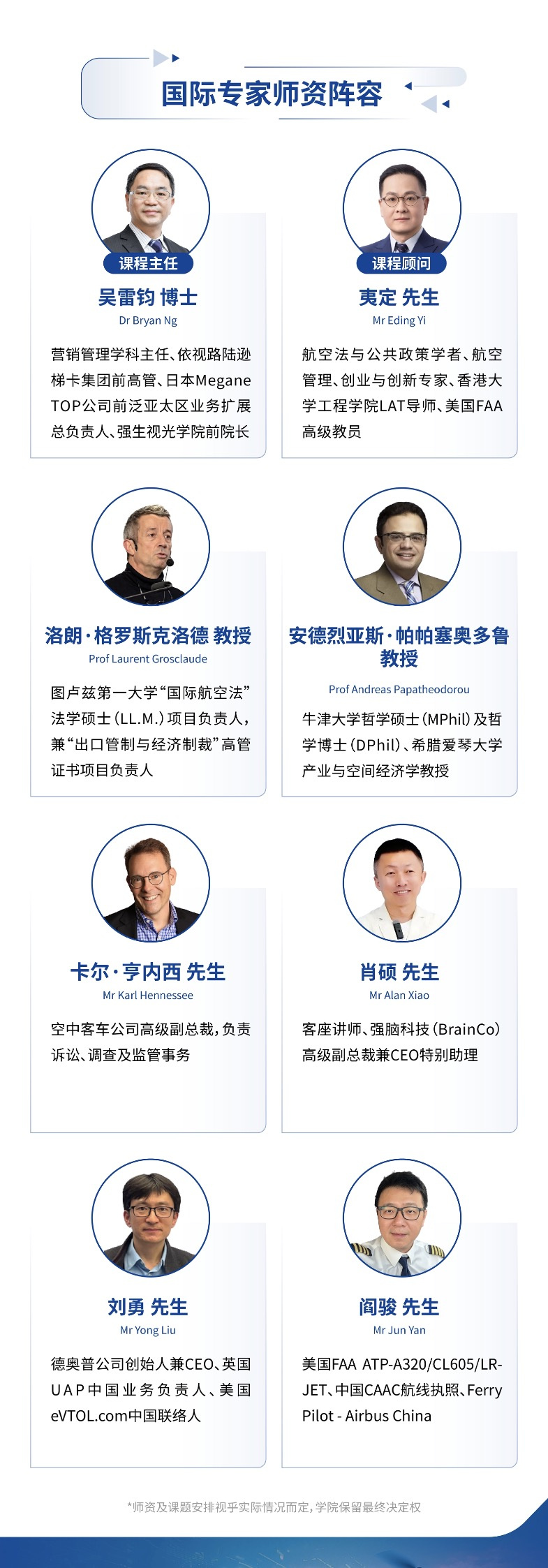
Teaching Members

Programme Content

  • Day 1 – Understanding the Future of Flight: Safety, Accident Investigation, and Flight Operations
  • Day 2 – Innovating Future Aircraft: Aerospace Manufacturing, Advanced Air Mobility (VTOL), and Product Innovation
  • Day 3 – Enabling Future Airspace: Infrastructure, Airspace Systems, and Scalable Aviation Operations
  • Day 4 – Commercialising Aviation Innovation: Business Models, Aviation Finance, and Asset Operations
  • Day 5 – Governing the Aviation Ecosystem: AI, Regulatory Frameworks, Legal Issues, and Societal Governance
 
Statement of Achievement

Upon completion of the course, with an attendance rate of 80% or above and passing the assessment, the participant will be awarded a Statement of Achievement issued by HKU ICB.

Application Guidelines

Step 1   Application Preparation
                > Download Application Form
                > Prepare the company business card

Step 2   Application Submission
                > Email the completed application form and company business card to icbenquiry@hku.hk

Step 3   Review
                > After receiving the application, we will review the application within 1 week.  
                > Successful applicants will receive the "Letter of Acceptance" and “Payment Notice” from the Institute after passing the vetting process.  

Step 4   Payment and Registration
                > Applicants are required to pay the tuition fee to the HKU bank account within the period specified 
                   in the "Letter of Acceptance" to reserve their place and complete the application process.
                > Registration arrangements will be notified in advance and the original ID will be verified during registration.
                > Review of all applicants will be conducted according to the order of their applications and places are 
                   subject to final confirmation by the Institute.

For further information, please contact our centres in Beijing, Shanghai, Shenzhen, Guangzhou, and Chengdu.

Fees and Charges

Tuition fee: HKD 38,000
Meal and Travel:Students are responsible for their own travel documents, visa, accommodation and transportation during their attendance of classes.